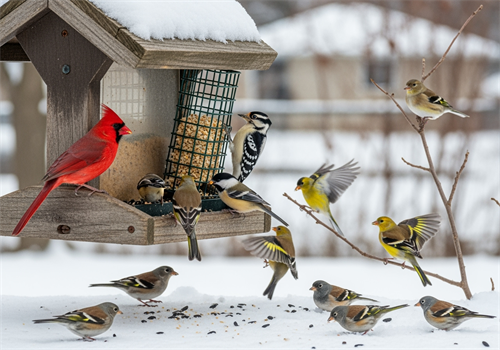
Birds are astonishing metabolic athletes. A chickadee can burn through a human’s daily energy allowance in grams of seed; a hummingbird’s heart can race past 1,000 beats per minute to keep nectar cycling; a laying hen or a breeding finch must juggle calcium, protein, and trace minerals on a razor’s edge. Whether you’re supporting wild visitors in the garden or caring for captive birds, the most reliable results come from treating avian feeding like a science experiment: set clear nutrition targets, choose ingredients that meet those targets, and deliver them safely with feeders designed around physics, hygiene, and species behavior.
Part I — Nutrition Fundamentals
1) Energy and macronutrient targets
Birds manage intense thermoregulation and flight costs, so energy density matters. For wild feeder flocks in temperate zones:
- Wintering small passerines (finches, chickadees, nuthatches): prioritize high-fat seeds (energy-dense,~550–650 kcal/100 g).
- Breeding season omnivores (sparrows, thrushes, starlings): tilt toward higher protein (insects/mealworms; 16–25% crude protein).
- Nectarivores (hummingbirds, sunbirds): nearly pure carbohydrate from sucrose solutions, with trace minerals from natural sources.
A useful working range for common feeder clientele:
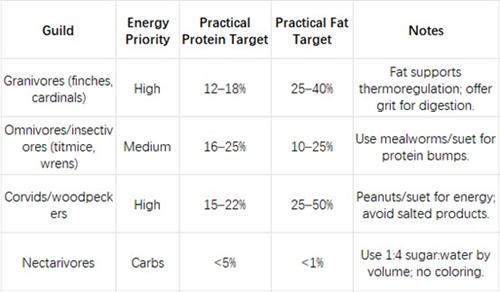
Rule of thumb: Energy first in cold or migration; protein first in molt or breeding; calcium always for layers/eggshell formation.
2) Micronutrients that actually move the needle
- Calcium & Phosphorus (Ca:P): Ideal dietary Ca:P is ~1.5–2.0:1 for layers and ~1–1.5:1 for maintenance. Supply via crushed eggshell (baked), oyster shell, or cuttlebone (for captive parrots, finches).
- Vitamin A: Seed-heavy diets risk deficiency, leading to keratinized epithelium and poor immune barriers. Counter with dark leafy greens (chopped kale, dandelion), orange veg (carrot, sweet potato), or formulated pellets for captive birds.
- Vitamin D3: Sun exposure helps, but indoor birds need D3 in balanced pellets; for wild birds, offer variety and ensure access to unspoiled foods—don’t try to supplement D3 ad hoc at a feeder.
- Sodium & Iodine: Avoid salted peanuts; trace iodine becomes relevant for captive softbill diets—use balanced formulations rather than iodized table salt additions.
- Omega-3s: Flaxseed and certain nuts contribute ALA; not essential at feeders, but beneficial in breeder formulations.
Part II — Ingredient Science: Why Black Oil Sunflower Rules (and Where It Doesn’t)
1) Black Oil Sunflower Seed (BOSS): The benchmark
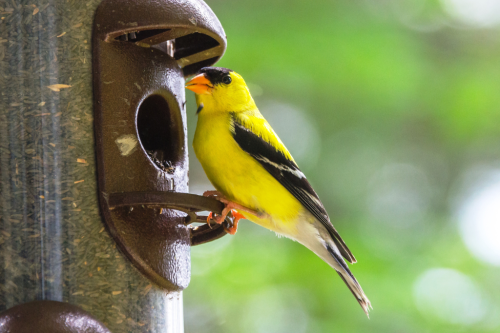
BOSS typically runs ~40–50% fat, ~16–20% protein, hulls are thinner than striped varieties, and kernels are richly caloric (~580–620 kcal/100 g). It’s accessible to small-billed birds, relatively affordable per kilocalorie, and produces high feeder traffic in winter. The high fat fraction supports thermogenesis; moderate protein supports molt and maintenance. It is also less likely to be wasted compared to striped sunflower because more species can crack the shell.
When to emphasize BOSS:
- Temperate/cold seasons.
- Targeting finches, chickadees, nuthatches, titmice, cardinals, grosbeaks, woodpeckers.
- You want a broadly attractive, “anchor” ingredient in a mix.
When to downshift BOSS:
- Summer in hot climates (reduce rancidity risk; rotate in safflower, millet, fruit, and insect protein).
- Where hull litter is a problem (consider hulled sunflower “hearts,” but store carefully to avoid spoilage).
2) How BOSS compares to common feeder staples
- Striped sunflower: Bigger seed, thicker hull; preferred by cardinals/jays but harder for small finches. Slightly lower fat vs. BOSS on average.
- Safflower:~35–40% fat,~16–18% protein; attracts cardinals, house finches; deters some squirrels and grackles. Good summer rotation.
- Nyjer (thistle):~30–35% fat,~18–20% protein; goldfinch magnet. Requires fine ports/mesh to avoid spillage; freshness critical.
- White proso millet:~11% protein,~4% fat; doves, sparrows, juncos love it; best in trays/ground. Cheap calorie filler but not a winter powerhouse by itself.
- Peanuts (in-shell or chopped):~45–50% fat,~25% protein; woodpeckers, nuthatches, jays. Never salted; watch aflatoxin risks—buy quality, store dry.
- Suet (rendered fat cakes): Extremely energy-dense; excellent in cold; can include mealworms or seed. Avoid in >75–80°F unless no-melt formulas.
- Fruits (apples, oranges, berries): Orioles, thrashers, waxwings; rotate fresh frequently to avoid fermentation/wasps.
- Mealworms/black soldier fly larvae: 45–60% protein (dry); top-tier breeding/molt support for insectivores.
Part III — Practical Mix Design
Think in percentages by weight and match ports to seed size so birds can actually extract what you offer.
1) All-purpose winter mix (mid- to high-latitude)
- 40% Black oil sunflower (BOSS)
- 20% Hulled sunflower hearts (reduces energy spent on shelling, boosts acceptance)
- 15% Safflower (broadens appeal, can deter some bully species)
- 10% Peanuts (chopped, unsalted)
- 10% Suet nuggets (or hang a separate suet feeder)
- 5% Nyjer (served from a side nyjer tube with fine ports)
Why it works:~35–40% fat overall; high energy density; mixed port sizes encourage guild diversity.
2) Spring/breeding support mix
- 30% BOSS
- 20% Hulled sunflower hearts
- 15% Safflower
- 20% Dried mealworms or BSFL (or 10% dried + cup of live daily)
- 10% White proso millet (sparrows, doves)
- 5% Fruit bits (unsulfured raisins, chopped apple offered fresh on a tray)
Why it works: Moves protein toward 18–22% for breeding and molt; still energy-sufficient for cool nights.
3) Yard diversity strategy (multi-feeder station)
- Nyjer tube for goldfinches/siskins.
- Peanut feeder (mesh) for woodpeckers, nuthatches.
- BOSS hopper/tube as the central attractant.
- Ground/tray millet for doves, juncos, towhees.
- Oriole station (orange halves + grape jelly in migration; minimize jelly in heat, use small quantities).
4) Captive bird considerations
For parrots, finches, and softbills in human care, evidence overwhelmingly favors balanced pellets as a base (typically 60–80% of intake), supplemented with:
- Seeds as training treats rather than free-choice staples (especially in species prone to obesity or hypovitaminosis A).
- Fresh veg (dark leafy greens, orange veg) 10–25%.
- Targeted seeds (BOSS/safflower/stripe sunflower) <10–20% unless formulated by an avian vet for specific needs.
- Calcium via cuttlebone/mineral block as appropriate.
Captive rule: Pellets for baseline micronutrients; seeds for enrichment and calories; fresh produce for fiber and vitamins.
Part IV — Safety & Quality Control
- Storage: Keep seeds cool, dry, dark. Rancid fat smells “painty” or sour—discard immediately. Rotate stock every 1–3 months depending on climate.
- Aflatoxins: Higher risk in peanuts and corn stored warm/humid. Buy reputable brands; avoid caking/damp bags; never use moldy feed.
- Disease control: Clean feeders weekly in cool weather and every 3–4 days in heat or after rain: wash, then disinfect (1:10 bleach, then rinse and sun-dry). Remove wet clumps; rake hull piles to limit bacterial growth.
- No additives: Avoid salted, seasoned, or sweetened human snack nuts; no food dye in nectar; no honey (fermentation/pathogen risk) for hummingbirds.
Part V — Feeder Engineering
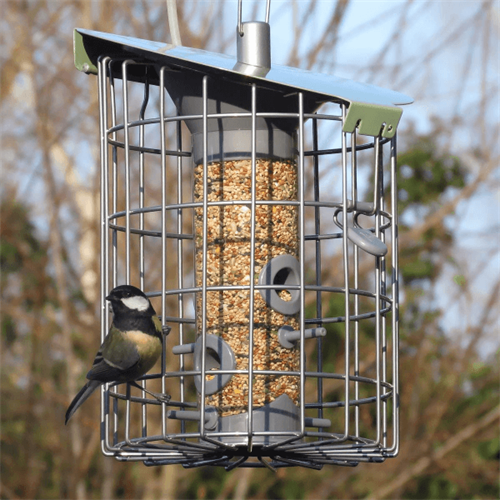
A funnel-style bird feeder typically works on a gravity-feed principle, using a slanted or cone-shaped chamber that guides seeds downward into the feeding openings. Performance lives or dies on three physics concepts: angle of repose, flow channelization, and aperture matching.
1) Geometry that prevents clogs
- Angle of repose: Most dry seeds flow reliably when hopper walls slope at ≥55–60° from horizontal (i.e., steep walls). Shallower slopes allow bridges to form and seeds to hang.
- Smooth, non-porous surfaces: UV-stable plastics or sealed wood reduce friction; seams should be minimized.
- Flow aids: Gentle internal ribs or a small central funnel can reduce dead zones; avoid sharp corners where fines accumulate.
2) Apertures and ports: match bird bills, limit waste
- Nyjer ports/mesh: 1.5–2.0 mm slots or fine mesh; too large wastes seed, too small stops flow.
- Sunflower/safflower ports: 8–10 mm oval/round; adjustable baffles let you fine-tune flow and deter large, aggressive birds.
- Peanut mesh: 10–15 mm grid for whole/chopped peanuts; smaller for chips.
- Perch length: 2–3 cm for small passerines; longer perches invite starlings/grackles. Use short, close perches to favor finches/titmice.
3) Drainage and weatherproofing
- Floor perforations: Multiple 3–5 mm holes to shed rain and prevent soupy seed.
- Roof overhang: At least 3–5 cm beyond the feed ports; sloped or domed.
- Removable base: For easy dump-and-clean after storms.
- Baffles and domes: Reduce squirrel access and shed rain; clear polycarbonate keeps sight lines open.
4) Placement strategy to maximize species diversity
- Height: 1.5–2.0 m above ground for general passerines; higher or with a pole baffle to deter squirrels.
- Habitat adjacency: Place within 2–5 m of shrubs/trees to give small birds escape cover, but not right against dense foliage (ambush points for cats).
- Line-of-sight: Hummingbird feeders should have clear aerial approaches; seed feeders can be near vegetation but with open arcs to avoid collisions.
- Multi-level design: Ground tray for doves/juncos, mid-height hopper for finches/cardinals, trunk-mounted suet for woodpeckers.
- Windows: Use decals, angled glass, or move feeders either <1 m or >10 m from windows to reduce strikes.
5) Maintenance schedules that actually work
- Routine:
- 2–4 days: Check for clumps, dump wet seed after rain.
- Weekly (cool): Wash with soap, rinse, 1:10 bleach or 3–5% hydrogen peroxide soak, rinse, dry fully.
- Every 2–3 weeks (hot): Increase to full disinfection.
- Inspection points:
- Cracks that trap moisture/fines.
- Port edges (seed dust + saliva = biofilm).
- Drainage holes (spider webs, seed paste).
- Record-keeping: Note fill rates and species counts. Abrupt drops can signal spoiled feed, predator presence, or disease advisories.
Part VI — Recipes & Formulations (Wild and Captive)
A) High-Energy Winter Suet (no-melt in mild cold)
- 1 kg rendered beef suet (or high-melt vegetable shortening blend)
- 300 g coarse cornmeal
- 300 g oat flour or quick oats
- 200 g peanut flour or finely chopped unsalted peanuts
- Optional: 100 g dried mealworms; 100 g chopped BOSS hearts
Melt suet gently, stir in dry ingredients, pour into molds, cool. Use cage suet feeders; remove in hot spells unless labeled no-melt.
B) Goldfinch Nyjer Blend (reduced waste)
- Nyjer 70%
- Fine hulled sunflower chips 20%
- Micro-chopped peanuts 10%
Serve in a fine-mesh or narrow-port tube with a rain cap. Replace after 4–6 weeks or if aroma fades (nyjer stales quickly).
C) Nectar for Hummingbirds
- White granulated sugar 1 part : water 4 parts (by volume)
Boil water, dissolve sugar, cool. No dye, no honey, no brown sugar. Replace every 2–3 days in warm weather; daily in heat.
D) Captive Finch/Canary Daily Plan (example)
- Pellets (balanced) 70%
- Fresh greens/veg 20% (kale, chicory, carrot micro-dice; rotate)
- Seed treat 10% (BOSS hearts and canary seed mix)
- Calcium: mineral grit/cuttlebone ad libitum; sunlight or full-spectrum lighting as advised by an avian vet.
E) Breeding Support Topper (2–4 weeks pre- and post-hatch for wild feeder assistance)
- Dried mealworms 50%
- Fine BOSS hearts 25%
- Peanut chips (unsalted) 25%
Offer in small trays early morning; remove leftovers by dusk to deter raccoons/rodents.
Part VII — Troubleshooting and Optimization
Problem: Seed hangs up in funnel/hopper.
Fix: Increase wall slope to ≥60°; polish surfaces; add a central cone; increase port size slightly; screen fines with a 3–4 mm sieve before filling.
Problem: Only house sparrows dominate.
Fix: Shorten perches, reduce millet fraction, use weight-sensitive perches or narrower ports; add nyjer tube for finches and suet/peanut feeders for woodpeckers to diversify.
Problem: Messy hull piles under feeder.
Fix: Switch part of the mix to hulled hearts; add a catch tray; rake hulls weekly to prevent fungal growth.
Problem: Squirrels raid nonstop.
Fix: Pole baffle placed below feeder, ≥1.2 m high; keep feeders >3 m horizontally and >2.5 m vertically from launch points; use safflower-heavy mixes where appropriate.
Problem: Mold after rain.
Fix: Improve drainage holes; use roof overhang; reduce fill level before storms; prefer flowy seeds (BOSS, safflower) and avoid sticky mixes in humid spells.
Problem: Bird illness outbreak reported locally.
Fix: Pause feeding for 10–14 days, remove all food sources, fully disinfect equipment, rake ground, then restart with fresh feed and enhanced cleaning frequency.
Part VIII — Measuring Success Like a Scientist
- Consumption rate (g/day): Track by feeder. If a 3 L hopper empties in a day, you’re likely over-attracting or inviting waste; if it lasts >3 weeks, staleness risk rises.
- Species richness: Count distinct species weekly. Adjust mix to broaden guild appeal (add nyjer for finches, suet/peanuts for woodpeckers, fruit for orioles).
- Body condition cues: For captive birds, monitor weight on a gram scale; for wild visitors, look for consistent activity and normal plumage.
- Waste index: Estimate % of spilled seed beneath feeders; aim to keep <10–15% with port matching and tray use.
- Seasonal pivot points: Shift from fat-forward winter mixes to protein-forward spring recipes 2–4 weeks before local breeding peaks.
Recommend:
Supporting Your Dog’s Gut Health: Probiotics, Products, and Homemade Recipes

Scientific Insights into Cat Diets: Tailoring Nutrition by Age, Breed, and Health Condition
A Guide to Stress Management in Exotic Pets: Recognition, Prevention, and Care

Organic vs. Conventional: Is Organic Pet Food Worth the Hype?